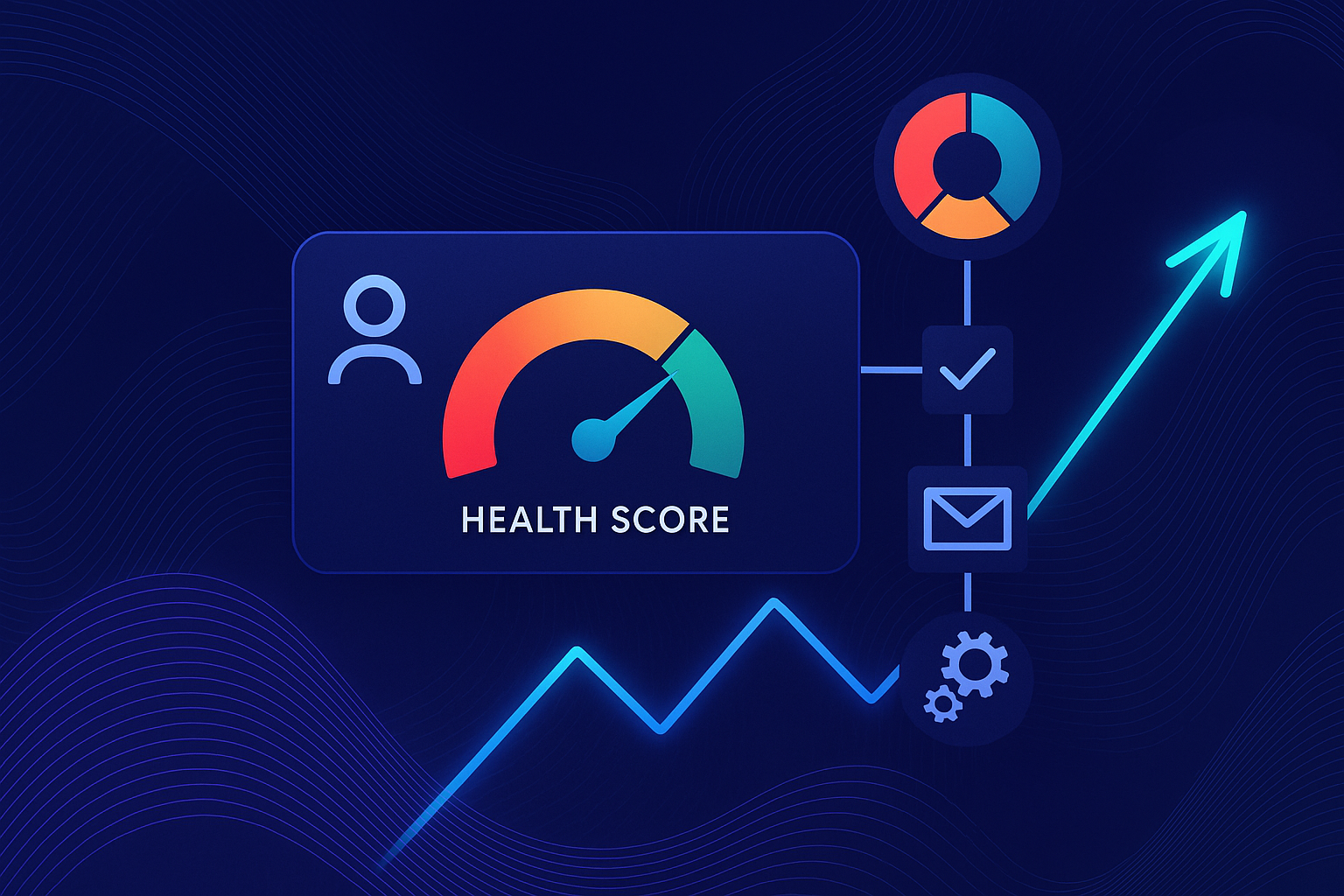
A customer health score is a structured way to surface renewal risk and expansion opportunity. It is a signal for a conversation, not a prediction that a customer will certainly stay or leave. The most useful score combines data the team trusts with a clear follow-up process.
Choose the account and outcome first
Decide whether the score applies to a company or a contact, and what decision it should support. A B2B SaaS team might use a company-level score to prioritize CSM outreach before renewal. Define what “healthy” and “at risk” mean in observable terms: product adoption, unresolved support issues, engagement with the CSM, or a contract milestone. Do not import a generic weighting system without testing it against your customers.
HubSpot's health score documentation describes scoring contacts or companies in the customer success workspace. It lists Service Hub subscription and permission requirements. Confirm that your portal has the needed access before designing a process around the native feature.
Select a small number of reliable inputs
Start with data you can explain. Usage should be normalized where account size differs; raw login count alone can make a large, disengaged customer look healthy. Support signals should distinguish an active escalation from ordinary ticket volume. CSM sentiment can capture context, but document what each rating means so one person's “neutral” is another person's “at risk.”
For each signal, record its source, refresh frequency, owner, and failure mode. If product usage reaches HubSpot through an integration, test what happens when the sync pauses. A stale score should be visible as stale, not quietly treated as healthy.
Configure and test the score
HubSpot supports event and property groups that add or subtract points under rules you define. Choose weights that reflect your business hypotheses, then test them on a sample of known healthy, recently lost, and borderline accounts. Inspect why each account received its score. A model that looks accurate only because it uses data recorded after a cancellation will not help the team intervene earlier.
Avoid too many overlapping signals. Several measures of the same behavior can double-count risk or reward. Keep the first version simple enough for a CSM to explain to an account owner. Revisit the thresholds after a full renewal cycle rather than tuning them every time one customer behaves unexpectedly.
Put the score on a dashboard with context
A dashboard should show the score alongside account owner, renewal date, recent change, open risks, and a next step. Segment views by portfolio or renewal window. A list of red accounts without owners is a reporting artifact; an actionable view tells the team who should investigate and by when.
Create a workflow only after the response is clear. For example, a score crossing a threshold might create a task for the CSM to review the account, not automatically send a customer-facing message. Test alert volume and false positives before expanding the workflow.
Measure whether the process helps
Track the proportion of at-risk accounts reviewed, time from alert to action, and the reasons scores were overridden. Compare those measures with retention outcomes over time, while remembering that correlation is not proof that the score caused a renewal. Interview CSMs about missed signals. A health score earns its place when it prompts earlier, better-informed customer work.